AIA· PROTOCOLS
Release I — Intake Regulation
Early Access
Application Only
Built for operators — not spectators.
Manual review. Selective enrollment.
Selection Frame
Early Access is limited.
We accept a small number of operators per cohort.
If alignment exists — you’ll be invited.
Outcome
Most systems chase behavior.
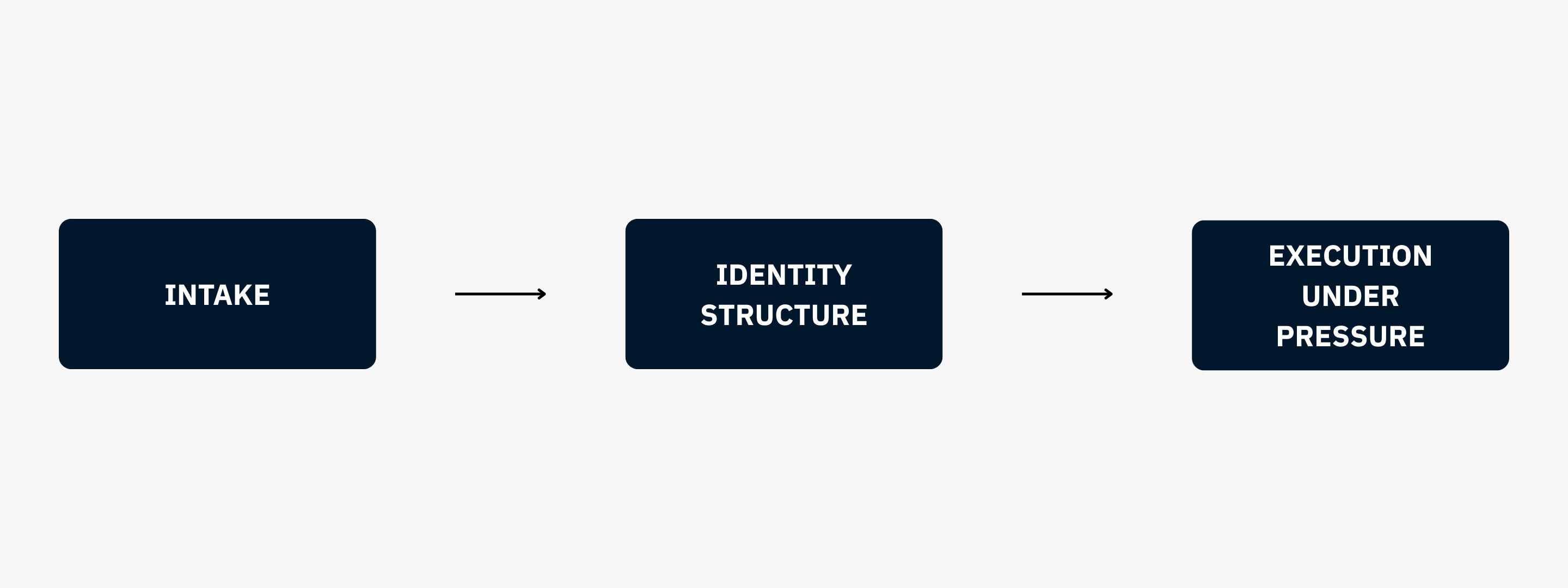
This protocol rewrites the structure producing it.When intake stabilizes, execution follows — especially under pressure.Early access cohorts are used to test, refine, and harden the protocol before public release.
Enrollment is selective to preserve signal quality.
What You Receive
Protocol: Release I — Intake Regulation
Foundational ESA stabilization layer inside AIA.
Identity Reconstruction Map
Integration checkpoints
All refinements through v1.0
Permanent Founder-Tier pricing
Direct update communication
Weekly System Calibration Loop (intake → execution → recalibration)
This is for operators — not spectators.
Who This Is / Is Not For
NOT For
People seeking motivation
People wanting emotional hand-holding
People unwilling to dismantle identity-level patterns
For
People with pattern awareness
People willing to be wrong — then rebuilt
People ready to implement structural change weekly
People who value structure over inspiration
Format & Capacity
Format
8-week operating protocol
Self-directed execution
Structural deliverables
Optional integration support
Capacity
3–5 operators per cohort.
Strictly vetted to preserve structural integrity.
Submitting an application does not guarantee enrollment.
The Application
This is not a sales call.
It is a structural fit assessment.If alignment exists — you’ll be invited.
.
© 2026 Cohera Systems. All rights reserved.
The Discipline Behind Cohera Systems
Applied Identity Architecture™ — the field this work comes from
Applied Identity Architecture is the discipline focused on how identity is structured, maintained, and changed at the level of behavioral defaults — not narrative, personality, or belief.It studies identity as a system:
patterns of response that emerge through repetition under pressure and become automatic over time.Cohera Systems operates within this discipline — translating its principles into diagnostics and implementation protocols designed to stabilize behavior where it is actually generated: at the structural level.This is not therapy.
Not coaching.
Not mindset work.It is applied structural reconstruction.Signal first. Structure next.
Applied Identity Architecture™
Identity is not who you think you are.
It is who your system defaults to under pressure.
Identity has traditionally been treated as narrative, personality, or belief.Applied Identity Architecture approaches identity differently.Identity is structure.
It is the system of defaults your brain and nervous system rely on when pressure rises, energy drops, or emotion intensifies.These defaults are not chosen in the moment — they are trained over time through repeated exposure, reinforcement, and environment.What repeats becomes architecture.Most approaches to change focus on:
motivation
insight
emotional processing
belief reframing
These can influence awareness.
They do not reliably alter default behavioral response under pressure.Applied Identity Architecture operates at the level where behavior is generated — not explained.It is the discipline of:
identifying the structural patterns that govern behavior
exposing where those structures collapse under constraint
retraining behavioral pathways through structured repetition
stabilizing new identity defaults through implementation under real conditions
This is applied neuroplasticity in practice.
Not learning in theory.
Training in context.Identity shifts when repeated behavior under pressure shifts.
Why Identity Must Be Reconstructed, Not Motivated
Motivation fluctuates.
Emotion fluctuates.
Circumstances fluctuate.Structure does not.When identity architecture is incoherent, behavior oscillates.
When architecture is rebuilt, behavior stabilizes without constant effort.Applied Identity Architecture™ is not about becoming someone new.It is about rebuilding the internal system that decides:
what you allow in
how you respond under stress
whether execution holds or collapses
This is structural work.And structure determines trajectory.
Where Cohera Systems Fits
Cohera Systems is the applied branch of this discipline.We build:
diagnostics that surface identity structure under pressure
protocols that retrain behavioral defaults through structured implementation
The IRDx diagnostic measures structural patterns.
The Intake Regulation Protocol retrains them.Signal → Structure → Reconstruction → StabilizationThat is Applied Identity Architecture™ in action.
.
© 2026 Cohera Systems. All rights reserved.
The Cohera Method
Behavior under pressure is not random.It follows structure.The Cohera Method is a systems framework designed to identify, deconstruct, and rebuild the identity architecture that governs intake, execution, and regulation under real-world stress.This method does not begin with goals.It begins with signal.
Stage 1 — Signal DetectionBehavior under pressure is treated as data.The IRDx diagnostic surfaces:
dominant identity patterns
collapse points under stress
regulation failures
compensation loops
This reveals how the current identity architecture is structured — not how it is described.We do not ask who you think you are.
We measure who your system becomes when conditions tighten.
Stage 2 — Structural MappingOnce signal is visible, patterns are mapped into architecture.We identify:
where identity collapses
where compensation replaces regulation
which environmental inputs reinforce instability
which internal loops maintain default behavior
This produces an Identity Map — the blueprint of how behavior is generated under pressure.
Stage 3 — Reconstruction DesignReconstruction does not target feelings.
It targets structure.Based on the Identity Map, we design:
behavioral constraints
environmental adjustments
pattern-specific interruption routines
repetition structures that retrain response pathways
This becomes your Reconstruction Route — the minimal set of interventions required to stabilize execution.
Stage 4 — Daily Implementation EngineReconstruction happens through structured repetition.The protocol runs through a weekly implementation engine that trains identity under pressure through:
Authority installation
Commitment exposure
Context override
Action under friction
Integration under real conditions
Each day trains a different structural function.
Each week increases load and complexity.This is not journaling.
Not reflection loops.
It is behavioral installation through repetition.Neural pathways that fire repeatedly under constraint become default pathways.That is the mechanism.
Pattern Routing (Personalization Layer)While the weekly engine trains universal identity functions, each participant follows an additional pattern-specific route based on their IRDx result.These pattern tracks target:
specific collapse tendencies
dominant avoidance strategies
default compensation behaviors
This ensures reconstruction is both:
structurally universal
and pattern-specific.
Stage 5 — Stabilization Under PressureThe final phase integrates the new architecture into real environments.Execution is tested under:
time pressure
emotional load
environmental unpredictability
Stability under pressure — not perfect behavior — is the success metric.When identity architecture holds under constraint, intake and execution stabilize as downstream effects.
Why This Method Works
Because identity is not changed through insight.It is retrained through repeated behavior under pressure.The brain is a use-dependent organ.
What repeats under stress becomes default.The Cohera Method applies that principle systematically.Signal → Map → Rebuild → Repeat → StabilizeThis is not self-improvement.It is structural reconstruction of identity.
.
© 2026 Cohera Systems. All rights reserved.
Founder's Note

From concept to system.
I didn’t build this to improve habits.I built it because I kept seeing the same structural failure repeat across high-capacity people:They could perform at a high level —
until pressure hit.Then execution fractured.
Not from laziness.
Not from lack of desire.
From incoherent internal structure.Most systems try to change behavior.
Some try to change mindset.Both operate above the layer where behavior is actually decided.Applied Identity Architecture™ was built to work underneath both —
at the level where identity becomes automatic response.This is not theory work.
It is not emotional processing.It is protocol engineering:
mapping where execution breaks, tracing failure back to structure, and rebuilding from the intake layer upward until behavior holds under pressure.This is a new discipline being built in public.
The diagnostics, the protocols, the refinements — all evolve through real-world constraint, not controlled theory.If you’re here, you’re not looking for motivation.You’re ready to rebuild the system running you.
— Joana
Founder & Systems Architect
Cohera Systems
.
© 2026 Cohera Systems. All rights reserved.